

Registering a business in Idaho is a sequence of decisions and filings rather than a single form. The owner chooses an entity type, confirms that the name is available, appoints a registered agent, and submits a formation document to the Secretary of State. Federal tax registration, a state sales tax permit, and local licenses may follow, depending on what the business actually does. This guide covers the formation and registration path for a new Idaho company.
It compares limited liability companies, corporations, and nonprofit corporations, describes the certificate and articles that create each one, and traces how foreign registration, tax numbers, paper filings, and processing dates fit together. Name reservations and assumed business names are addressed in the name availability article, so this page mentions them only where the filing sequence requires it.
How to Register a Business in Idaho
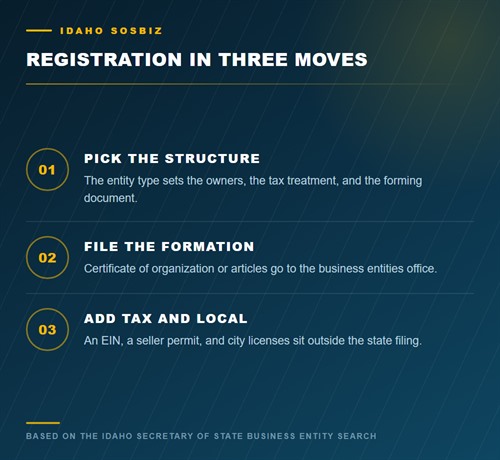
The order that works begins with the entity choice and ends with the permits that apply to the physical operation. An owner should settle the entity type, clear the name, identify a registered agent with an Idaho street address, and prepare the formation document before paying a filing fee. After the Secretary of State approves the document, the business can obtain an employer identification number, apply for a sales tax permit if needed, and contact the city or county about local licenses.
Label:
https://sosbiz.idaho.gov/
Formation filings go through SOSBiz, the business portal maintained by the Secretary of State. Online submission is less expensive than paper, and it gives the filer a chance to correct missing fields before the document enters the queue. Paper filings are still accepted, but they carry a manual processing charge and travel through a slower channel.
An account on the portal also makes it easier to retrieve receipts and check the status of a submission.
The information on the formation document should match the name search, the operating agreement or bylaws, and the records that the business will use with its bank. A mismatch between an LLC certificate and a later tax application can create questions that take time to resolve. Checking the spelling, the entity ending, and the address fields before submission is a small habit with a large payoff.
Choosing an Entity Type
The entity type determines who owns the business, how it is taxed, and which document creates it. Idaho offers several structures, and the right choice depends on the number of owners, the need for outside investors, the desired tax treatment, and the level of formality the owners will maintain. The choice also sets the tax filing, the governance paper, and the report the office sends each year.
Limited Liability Company
A limited liability company gives its owners a liability shield without the formal hierarchy of a corporation. By default, a single-member LLC is disregarded for federal tax purposes, while a multi-member LLC is treated as a partnership unless it elects otherwise. Idaho creates the company through a certificate of organization. An operating agreement is not filed with the state, but it is the document that sets out ownership percentages, voting, distributions, and what happens when a member leaves.
Corporation
A corporation is a separate legal person owned by shareholders and governed by a board of directors. It files articles of incorporation, adopts bylaws, holds organizational meetings, and keeps minutes and stock records. That structure suits businesses that plan to raise capital or issue equity to employees. A corporation may elect S corporation treatment with the Internal Revenue Service to avoid the double taxation that applies to a standard C corporation, but the election is a federal tax choice rather than part of the state formation filing.
Nonprofit Corporation
A nonprofit corporation pursues a mission rather than distributing profits to owners. It has directors and possibly members, but it does not have shareholders. The articles must include the nonprofit character of the organization and the purposes it will pursue. Tax-exempt status under section 501(c)(3) of the Internal Revenue Code is a separate federal application, and the state formation filing does not grant it. A nonprofit that plans to solicit donations should budget time for the federal process after the state approval.
Sole Proprietorship and General Partnership
A sole proprietorship requires no state formation filing, and a general partnership can arise from an agreement without a registration. Both expose the owner or partners to personal liability, and both may need an assumed business name if they trade under a name different from the owner’s legal name. An owner who starts small can begin as a sole proprietor and later form an LLC, though the transition involves new records, tax accounts, and contracts.
Clearing the Proposed Name
Before drafting the formation document, run an Idaho company search against the SOSBiz records. Search the distinctive words, not just the full title, and review close spellings and related entity types. Write down the exact name that appears on any similar record and compare it after removing punctuation and endings. A name that survives that comparison is a better candidate for the filing.
Rechecking the Name on Filing Day
Repeat the search on the day of submission, because the record can change while an owner works on an operating agreement or waits for signatures. A short reservation can hold a name during that window, but the rules and duration of reservations belong to the name availability discussion. The registration task here is to make sure the final document uses a name that the office will accept.
Certificate of Organization Versus Articles of Incorporation
Idaho uses different labels for the document that creates each entity. A limited liability company files a certificate of organization. A corporation and a nonprofit corporation file articles of incorporation. Both are submitted through the same portal and both trigger a review of the name and the required information, but the statutory content differs enough that an owner should not reuse one form for the other.
What an LLC Certificate Contains
The certificate identifies the company name, the principal office, the registered agent, and the organizer who submits the document. It may also state a delayed effective date if the owners want the company to begin on a specific day. The certificate does not need to list every member or describe the operating agreement. Those details stay in the private agreement, which is why an LLC can keep its ownership structure out of the public file.
What Corporate Articles Contain
Articles of incorporation identify the corporation, its registered agent, its principal office, and the incorporator. They state the purpose and the authorized shares, and they name the initial directors in many cases. A nonprofit version adds the required nonprofit language and may describe the mission and the distribution of assets if the organization dissolves.
Keeping Private Details Out of the Articles
The articles are a public document, so an owner should avoid putting private information in a field that does not require it. The label on the document should match the entity type that will actually operate. Filing articles for a company that intends to function as an LLC creates a mismatch that has to be corrected, often through another filing and another charge. The choice should be settled before the document is drafted rather than after the name has been reserved.
Appointing a Registered Agent
Every Idaho entity must maintain a registered agent with a physical street address in the state. The agent receives service of process, notices from the Secretary of State, and other official communications. An individual agent must be an Idaho resident, and a business agent must be authorized to do business in Idaho. A post office box is not enough for the registered office address.
Consent Before the Appointment
The agent should consent before being named. A commercial service provides a documented acceptance process, while an individual should confirm in writing that they are willing to receive legal papers. Naming an agent without that consent can leave the entity without a reliable recipient for a summons, which defeats the purpose of the requirement.
Switching From an Owner to a Service
Many owners serve as their own agent at first and later switch to a commercial service when privacy or travel becomes a concern. A change of agent is filed with the Secretary of State; the online version carries no state fee, while a paper filing carries a charge. The change should be made promptly, because a missed legal notice can lead to a default judgment or an administrative dissolution even when the business is otherwise healthy.
Principal Office and Mailing Address
The principal office is the place where the business keeps its main records, and the mailing address is where the office sends correspondence. The principal office may be outside Idaho for an Idaho entity, but the registered agent must remain at an Idaho street address.
Home Offices and Privacy
A home-based business can use its home address, although an owner should weigh the privacy cost of placing that address in a public record. When the principal office or mailing address changes, the entity should update the state record so that notices continue to arrive. A forwarding order from the post office is not a substitute for a filed change.
Separating the Filing Address From the Home
A commercial registered agent or a co-working address can separate the public filing from a residence. Whatever address is chosen, it should be one where mail is actually opened and acted upon. A stale address on the state record can cause an annual report notice to be missed, which in turn can lead to administrative dissolution and a reinstatement filing.
Registering a Foreign Entity in Idaho
A business formed in another state that transacts business in Idaho must register as a foreign entity. The filing is a foreign registration statement, and it requires a registered agent in Idaho along with proof that the company is in good standing in its home jurisdiction. A certificate of existence from the home state is the usual evidence, and it should be current when the Idaho filing is submitted.
Home Jurisdiction and Formation Date
The registration statement also asks for the home jurisdiction and the date of formation. A company that later changes its home name or merges with another entity should update the Idaho record rather than let the foreign registration describe an organization that no longer exists.
Assumed Name for a Foreign Company
If the foreign company’s legal name is already taken in Idaho, the registration can proceed under an assumed name that the company adopts for use in the state. The foreign entity must also keep its Idaho registration current and file annual reports. When the company stops doing business in Idaho, it should file a withdrawal rather than simply stop responding, because an inactive registration can produce penalties and complicate a future return.
EIN and Tax Permit Sequence
Tax registrations come after the formation document is approved, not before. The employer identification number is a federal identifier, while the sales tax permit is a state authorization. An owner should obtain the federal number first, then use it on state applications, bank forms, and payroll records. Starting with the state permit often means repeating the work once the federal number arrives.
Federal Employer Identification Number
The Internal Revenue Service issues the employer identification number at no charge. A responsible party applies online and receives the number promptly in most cases. The number is required for a bank account, employee payroll, and many tax filings. A single-member LLC without employees may not be legally required to obtain one, but many owners do so to keep a Social Security number off vendor forms and to simplify banking.
Idaho Sales Tax Permit
A seller’s permit comes from the Idaho State Tax Commission, not the Secretary of State. It authorizes a business to collect sales tax on taxable tangible goods and on certain services. Whether a particular service is taxable depends on its nature, so an owner should review the state guidance or ask the Tax Commission rather than assume that a service business is exempt. The permit is separate from the entity registration and must be kept current as the business changes.
Local Licenses and Permits
City and county requirements sit on top of the state filing. A home-based business may need a home occupation permit, a restaurant may need a health district inspection, and a contractor may need a state registration in addition to a local license. Zoning, signage, fire occupancy, and parking rules can affect a location before a lease is signed.
Mapping Local Rules Before a Lease
Owners who need to map those obligations can consult an Idaho license guide before committing to a site. Signage and parking rules can be part of the local approval even when they are not labeled as business licenses. A tenant should read the lease for restrictions on hours, noise, and exterior signs before paying a deposit.
Calling the City or County Office
The local office that handles business licenses varies by jurisdiction. A short call to the city clerk or the county planning department can reveal whether a proposed use is allowed and which inspections apply. Doing that work before the state formation filing is not required, but it prevents a business from being formed for an address where it cannot legally operate.
Paper Filings Versus Online Filings
Online filing is the faster and less expensive route for most formation documents. The portal checks required fields, calculates the fee, and accepts payment in the same session. A filer receives a confirmation that can be saved with the entity records. The paper route requires a printed form, a signature, a check or money order, and a mailing envelope, and it adds a manual processing charge to the state fee.
Payment and Receipts by Route
Payment method also differs. The portal accepts electronic payment and produces an immediate receipt, while a mailed filing depends on a check or money order and may be returned if the amount is wrong. An owner who mails a document should use a trackable delivery method and keep the tracking number with the copy.
When Paper Still Makes Sense
Paper still has a place when an owner cannot use the portal, when a document needs an attachment that the online form does not support, or when a filing must be mailed with other materials. In those cases, the owner should send a complete package and keep a copy of every page. A missing signature or an incorrect fee can return the entire package and add another round of delay.
Processing Dates and Follow-Up
Online filings usually move through review faster than paper filings, but the office works through a queue and timing varies with volume. The portal shows the status of a submission, so an owner can check without calling. If a filing appears stalled beyond the posted estimate, a polite inquiry to the business entities office is reasonable, but submitting a second copy while the first is pending can create duplicate records and more work.
When a Filing Takes Effect
A document is generally effective when the office accepts it, unless the filing states a later date. An owner who needs the company to begin on a particular day should confirm how the portal handles a delayed effective date and should file early enough to allow for review. Retroactive effective dates are not something to assume.
Calendaring the First Report
After approval, the entity should calendar its annual report. Idaho reports are due by the last day of the entity’s formation month. The online report carries no state fee, while a paper report does. A reminder set several weeks before the deadline is more reliable than a memory of the formation date, and it keeps the entity in good standing for banking, contracts, and future filings.
Registration Fees
The table below lists the base state charges for the formation and foreign registration filings covered in this guide. Online submission is cheaper in every row, and paper submissions add a manual processing charge. The amounts are state fees only; they do not include legal advice, an operating agreement, a registered agent service, or local permits.
| Filing | Fee | Notes |
|---|---|---|
| LLC certificate of organization | $100 | Online; $120 on paper. |
| Corporation articles of incorporation | $100 | Online; $120 on paper. |
| Nonprofit articles of incorporation | $30 | Online; $50 on paper. |
| Foreign registration statement | $100 | Online; $120 on paper. |
Keep the receipt, the approved document, and the confirmation number together in the entity’s permanent file. A bank or a vendor may ask for evidence that the company exists, and the approved filing is the document that answers that question. A certificate of existence from the Secretary of State can provide separate confirmation when a third party requires it.
Frequently Asked Questions
These answers cover the points that owners raise after the formation document has been approved and the business is preparing to open.
Do I Need an EIN to Form an Idaho LLC?
No. The state formation filing does not require an employer identification number. The number becomes necessary for banking, payroll, and federal tax filings, and many owners obtain it soon after approval. It is issued by the Internal Revenue Service rather than the Secretary of State.
Can I Use a Home Address as My Principal Office?
Yes, an Idaho entity can list a home address as its principal office if that is where records are kept. The registered agent must still have an Idaho street address, and the owner should consider whether the public record will expose a residence. A commercial agent or co-working address can provide separation.
How Long Does Idaho Take to Approve a Filing?
A portal submission usually clears review sooner than a mailed package, though the office processes in arrival order. The dashboard shows where a filing stands. Sending a second copy while the first is pending creates a duplicate record and extra work.
Does an Idaho LLC Need an Operating Agreement?
Idaho does not require an LLC to file an operating agreement with the state, but a written agreement is still valuable. It defines ownership, voting, distributions, and exit rights. Without one, the owners may have to rely on default statutory rules that do not match their expectations.
What Happens If I File Under a Name That Is Already Taken?
The office may return the document and cite the conflicting record. The owner can then choose a different name and submit a new filing. Searching the SOSBiz record immediately before submission reduces the chance of that outcome, but it does not eliminate it because new filings arrive continuously.