

Idaho company search starts with SOSBiz, the online business entity system run by the Idaho Secretary of State. The register holds every entity organized in Idaho and every foreign entity registered to do business there, including limited liability companies, business corporations, nonprofit corporations, limited partnerships, and limited liability partnerships. A record returns the legal name, the entity number, the entity type, the status, the formation date, the registered agent and office, the principal office, and the filings the entity has submitted.
This page covers the records the state keeps, how to query them, what each field on a business record means, and which office holds the material the register does not carry. It is written for buyers checking a supplier, landlords screening a tenant, founders confirming their own filing, and researchers working through public records. Every state charge appears in a table rather than in the body text.
How to Search Idaho Business Entities
The business search is free and needs no account. It accepts a legal name, an entity number, or an entity type, and it returns a list of matching records with a status beside each result. Opening a result shows the business details: the name, the number, the type, the status, the dates, the office, and the agent on file. The data comes from the same system that accepts filings, so a document appears after the office processes it.
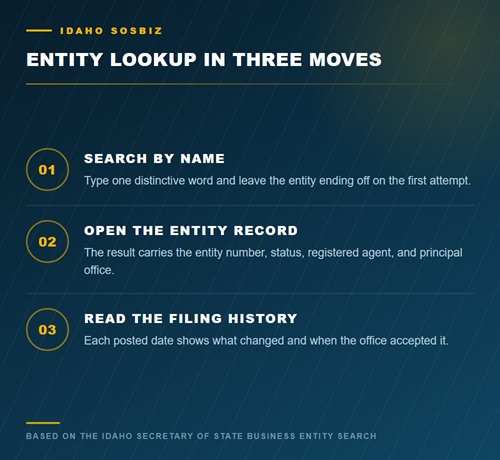
Search by Business Name
Enter the most distinctive word in the name and leave punctuation out. Idaho stores suffixes such as LLC, Inc., and Corp. in the name field, but the match handles them unevenly, so a first pass without the designator usually returns more results. The search matches on words rather than exact strings, which makes one unusual word the fastest route to the right entity.
Reading a Long Result List
Expect several results for a broad word. Compare the entity number, the type, and the principal office before you settle on one, because two companies can carry similar names and still be unrelated businesses. A near match is not proof of a relationship, and a missing match is not proof that a business does not exist.
Search by Entity Number
The entity number is the cleanest lookup and the only one that returns a single record. Idaho assigns it at formation and keeps it with the entity through name changes and address changes. Copy it from a filing or a certificate rather than retyping it, and enter it without spaces or dashes. One wrong digit returns an empty result that looks like a dissolved company.
Search by Entity Type
The register can be filtered by entity type, which helps when a name is too broad to narrow. A filter for limited liability companies removes the corporations and the partnerships from the list. Use it after a word search rather than instead of one, because the filter does not rank the results by relevance.
Idaho SOSBiz business search:
https://sosbiz.idaho.gov/
What an Idaho Company Search Covers
An Idaho company search is a lookup of the state’s central business registry, kept by the Secretary of State’s business entities office. The registry covers entities organized in Idaho and entities organized elsewhere that registered for authority to do business in the state. It also covers nonprofits and the partnership forms, which are easy to miss when a search is limited to LLCs and corporations.
What the Register Leaves Out
The Idaho LLC records page covers the LLC side of the register in detail. The register is a filing system rather than a credit bureau. It confirms that an entity exists, who accepts service for it, and what documents it has submitted. It says nothing about revenue, payment behavior, lawsuits, or the quality of the work, and those questions need a different source.
Who Holds Idaho Business Records
Idaho spreads business records across several offices, and a complete check usually touches more than one. The Secretary of State holds entity filings and assumed business names. The Idaho State Tax Commission holds tax permits and withholding accounts. Professional boards hold occupational licenses. Cities and counties add local licenses and permits. A search that stops at the entity record confirms the company, not its tax account or its license.
| Record | Office | What it proves |
|---|---|---|
| Entity formation and status | Secretary of State | The business is registered as an LLC, corporation, or partnership |
| Assumed business name | Secretary of State | The entity trades under a name other than its legal name |
| Tax permit | Idaho State Tax Commission | The business holds a sales or withholding account |
| Occupational license | State licensing board | The business may perform a regulated activity |
| Local license | City or county | The business may operate at a specific location |
The Secretary of State
The business entities office accepts certificates of organization, articles of incorporation, foreign registration statements, amendments, annual reports, agent changes, and dissolutions. It issues certificates of existence and copies of filed documents. When you need the legal existence of an Idaho business, this is the office that answers the question.
The Idaho State Tax Commission
The Tax Commission issues seller permits and withholding accounts, and the two are separate accounts that can exist without each other. A business can hold a tax permit without a current entity registration, and the reverse is also true. Check both when a tax question matters, because neither office confirms the other’s record.
Licensing Boards and Local Units
Idaho has no single general business license, and a board credential is separate from the entity record. Regulated trades hold credentials from a state board, and cities and counties add their own permits. A state entity record confirms registration, not permission to operate in a regulated field.
Inside a Business Record
The record is short, and each field answers a different question. Read the fields in order rather than jumping to the name, because a name match is not an identity match. Two entities can share a similar name, sit in different counties, and carry different people, so the entity number and the formation date are what separate them.
Legal Name and Entity Type
The legal name is the name on the formation document, not the sign above the door. The entity type tells you whether the record belongs to an LLC, a business corporation, a nonprofit, or a partnership. That distinction matters because the formation document, the annual report, and the governing rules all follow the type.
State Number and Key Dates
The entity number is the state’s identifier for the business. It stays with the entity through name and address changes and never transfers to another business. The formation date is when the office accepted the formation document, not when the business opened. Contract authority, tax years, and any claim about longevity hang on that date.
Status
The status line is the fastest way to tell a live record from a closed one. A current filing history usually sits behind an active value, while a gap in the reports accounts for most inactive records. The status page covers the values in detail, so here the line works as a pointer rather than a full definition.
Registered Agent and Office
Every Idaho entity keeps a registered agent with a physical Idaho address, and the registered office appears beside the agent name. The agent accepts service of process and official mail. The principal office is the business address on file, which can trail the real office by months.
Filing History
The history lists the documents the entity has submitted: formation, annual reports, amendments, agent changes, mergers, and dissolution. A gap often describes a dissolution and a later reinstatement. A thin history on an old company deserves a second look, since filings may be missing or recorded under a different name.
How Entity Type Changes a Search
The entity type sits beside every result, and it changes how a record should be read. Idaho files LLCs, corporations, nonprofits, and the partnership forms in one index, so a name alone does not tell you what kind of organization you are looking at. Read the type before the name. The class also decides which report form the office sends and which fee schedule applies.
LLCs and Corporations
An LLC is formed by filing a certificate of organization, while a corporation files articles of incorporation. The two records look alike at the top and differ in the governing document and the tax treatment. The type field keeps them apart even when the names are close.
Nonprofits and Partnerships
A nonprofit record carries a stated purpose and a board rather than shares. A partnership record shows the general partner or the contact partner. Both types carry a status and a filing history, so the reading method does not change, only the fields that matter.
How Fresh the Record Is
A search result is a live view, and a live view moves. Idaho publishes a processed-through date on the portal, and a filing that arrived after that date will not show until the queue clears. A record that read active last month can read inactive this month without any change to the business itself, only to its calendar.
When a Filing Has Not Posted
A filing accepted at the counter may take several days to post. The receipt proves the office received the document, and the record catches up when the work is done. A reader with a closing date should keep the receipt beside the search printout rather than assume the record is wrong.
Searching by Assumed Business Name
An entity that trades under a name other than its legal name files a certificate of assumed business name with the Secretary of State. The certificate is a separate record, and the search can return it without showing the company behind it. Read the certificate to find the entity number, then open that record to confirm the owner and the status.
Assumed Names Without an Expiration
Idaho does not put an expiration date on an assumed name. The certificate stays in effect until the owner files a cancellation, which is why an old trade name can sit in the index long after the storefront closed. The Idaho name availability page covers the reservation route when a proposed name is free.
What the Entity Type Does Not Tell You
The type field settles how the entity is organized, not how it is taxed. An LLC can be taxed as a partnership, a corporation, or a disregarded entity, and a corporation can elect pass-through treatment. The state record shows the legal form, and the tax classification sits with the Internal Revenue Service and the state tax office.
Ownership Sits Outside the Type Field
The type also says nothing about ownership. A corporation issues shares, an LLC issues membership interests, and a partnership uses partner interests, but the public record does not list the holders. A buyer who needs the ownership picture should ask the company for its governance document, its ownership schedule, and its tax returns.
Records the Portal Does Not Index
SOSBiz indexes entity filings and assumed names, not liens, judgments, or permits. A UCC financing statement sits with the Secretary of State in a separate UCC system, and a judgment sits with the court that entered it. A tax permit sits with the Idaho State Tax Commission, and an occupational license sits with the board that issued it.
Working Through the Offices in Order
A reader who needs a complete picture should work through the offices in order: the entity record, the UCC index, the tax permit, the license for the trade, and the local permit. Each office answers one question, and none of them confirms the others.
Reading a Filed Document
The formation document creates the entity and names the agent, the office, and the organizers. An amendment changes a term in that document, a merger combines two entities, and a dissolution closes the record. Each document has its own date and its own filing number, and the history lists them in the order the office accepted them.
Certificates Are Not Filed Documents
A certificate of existence is not a filed document. It is a statement the office issues on request, and it speaks only to the date printed on its face. Keep the certificate with the record rather than in place of it, because the record carries the fields the certificate leaves out.
Working With the Processed-Through Date
The portal publishes the date through which filings have been processed. A document mailed after that date will not appear, even when the office received it, and a reader who checks too early can mistake the delay for a rejection. Compare the receipt date with the processed-through date before you call the office.
Calling the Office With the Entity Number
Calling with the entity number and the filing date resolves most questions in minutes. Filing a second copy while the first is in the queue only creates a duplicate fee and a second receipt, and the duplicate is harder to unwind than a short wait.
Searching a Name That Changed
An entity that changes its legal name keeps the same number, and the current record shows only the new name. A search on the old name can return nothing, even though the company still exists. If you know the number, search it; if you do not, open the record under the current name and read the filing history for the amendment.
Former Names on Contracts and Licenses
Contracts and licenses may still carry the former name, which is why a buyer should ask whether the company has operated under another name. The filing history shows the amendment date, and a certificate issued after the change will show the current name only. A name change does not reset the annual report cycle, and it does not change the entity number or the tax account.
What the Search Cannot Tell You
The register confirms registration and status, and it stops there. It does not report revenue, credit, liens, lawsuits, or complaints, and it does not confirm that the business pays its bills. It also does not show a tax permit or an occupational license, because those records live in other offices. For those questions you need the other agency or a commercial report.
Certificates and Copies
The search itself costs nothing, and a reader can view a business record without an account. A certificate of existence, which banks and buyers often call a certificate of good standing, is ordered from the record page and carries a modest state fee. Copies of filed documents are priced by the page, and certification adds a charge to the copy. A certificate ordered online can be downloaded the same day, while a mailed request adds transit time on both ends. The business records page covers the order routes and the wording of each document.
Idaho Filing Fees in Brief
The figures below are the published state charges for the filings most new businesses request. Idaho charges a lower rate online and adds a manual processing fee to a paper filing. A fee is paid when the document is filed, not when a name is searched.
| Item | Cost | Notes |
|---|---|---|
| LLC certificate of organization | $100.00 | Online; $120 paper |
| Business corporation articles | $100.00 | Online; $120 paper |
| Nonprofit articles | $30.00 | Online; $50 paper |
| Annual report | $0.00 | Free online; $20 paper |
| Certificate of existence | $10.00 | Per certificate |
Printing and Saving a Result
A browser print includes the page furniture, which wastes space and hides the fields that matter. Print to PDF, crop to the record panel, and note the date and time in the file name. A reviewer who sees the timestamp knows which version of the record the copy describes. The copy should be legible at full size. Keep the saved file with the contract or the application it supports. A folder of undated screenshots is very hard to defend, while a dated file with the entity number in its name can be matched to a transaction in seconds.
Records for a Vendor Check
A vendor check usually needs three records: the business record, a certificate of existence, and any assumed business name the company uses. A regulated trade adds a license from the relevant board. Keep a dated copy of each, since a dispute can turn on what the record showed on the day you signed. Note the entity number, the status, the date, and the name of the person who confirmed it. A short one-page checklist is easier to repeat before each renewal than a folder of screenshots, and it gives you a clear answer when a contract comes up for review.
Frequently Asked Questions
The questions below come from readers checking a supplier, a landlord, or their own registration. Each answer points to the office or the field that settles it.
Is the Idaho company search free?
Yes. SOSBiz costs nothing for a public search and does not require an account. You pay only for filings, certificates, and copies.
Where do I find the entity number?
It appears on the formation acknowledgment, on each annual report receipt, and on a certificate of existence. Copy it from one of those documents rather than from a directory site, because one wrong digit returns an empty result.
Does Idaho require an annual report?
Yes. Every entity files an annual report by the last day of its formation month, and the online filing costs nothing. A paper report adds a manual processing fee, and a missed report can lead to dissolution.
What is a certificate of existence?
It is Idaho’s version of a certificate of good standing. It states that the entity exists on a specific date and is ordered from the record page for a state fee.
Can I search by owner name?
The search accepts a person name, but it matches the registered agent field rather than an ownership schedule. Idaho does not publish members or shareholders as a searchable index, so a person search is a lead, not proof of ownership.