

A business name is the first public decision most owners make, and in Idaho it is also a regulated one. The Secretary of State’s business entities office will not accept a filing that uses a name already claimed by another registered entity, and the review is stricter than many people expect. A name that looks different on a sign or a website can still fail because the state compares names after stripping away punctuation and entity endings.
This article concentrates on availability and reservation. It describes how the state test works, how to search the SOSBiz portal, which endings each entity type requires, how reserved names and assumed business names differ, why a reservation is not a formed company, and what to do when a name is refused. The filing sequence for a new company is handled in a separate guide.
How to Check Idaho Business Name Availability
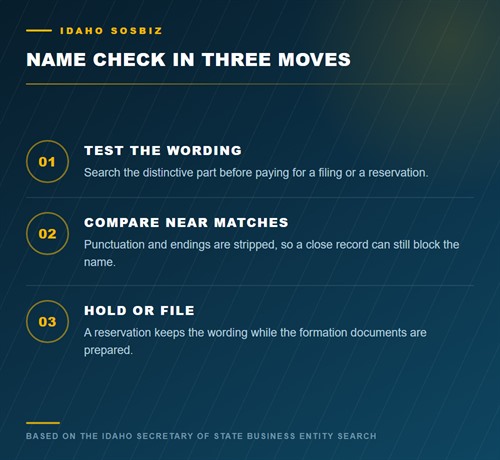
Begin at the Secretary of State’s business portal, SOSBiz. The entity search is open to the public, so an account is not required to look up a name. Enter the distinctive portion of the proposed name rather than the full legal title. If the idea is “Cedar Ridge Outdoor Supply LLC,” search “Cedar Ridge” first, then “Cedar Ridge Outdoor,” then the complete phrase. The search returns registered entities, reserved names, and other records that the office maintains.
Label:
https://sosbiz.idaho.gov/
SOSBiz is the same system that receives and stores business filings, which makes it the most reliable public record for this purpose. A clear result is not a reservation and it is not a guarantee. It means that no matching record appeared at the moment of the search. New filings arrive every business day, so a name that is open on Monday can be claimed before a Friday submission.
Run more than one query. Try phonetic variants, singular and plural forms, and abbreviations that a customer might use. Record the date of each search and save the result pages as PDFs. Those notes are useful if a filing is questioned later, and they help an owner avoid repeating the same search after a long delay.
Why a Name Check Belongs Before Any Paperwork
Filing first and checking afterward reverses the order and creates avoidable delay. The business entities office reviews the name when a document arrives. If the name conflicts, the filing is returned, the launch schedule slips, and the desired name may be claimed by someone else during the interval.
What a Few Minutes of Searching Prevents
A search takes minutes and can be repeated just before submission, which is a small cost compared with rebuilding stationery, domains, and contracts around a rejected name. The check also has a commercial value beyond compliance.
Reading the Competitive Picture
A name that is already in use by several nearby businesses can signal a crowded niche or a brand that customers associate with someone else. Seeing the existing field early gives an owner room to choose a term that is both available and meaningfully different, rather than discovering the overlap after a marketing budget has been spent.
The Distinguishability Test Applied to Idaho Names
Idaho does not demand a completely original name. It demands a name that is distinguishable from names already on the record. To make that judgment, the office sets aside punctuation and entity designations, then compares what remains. “Summit Holdings, LLC” and “Summit Holdings Inc.” can therefore collide, because “Summit Holdings” is the same once the endings are removed.
How Endings Are Stripped and Compared
Commas, periods, hyphens, and apostrophes do not create separation on their own. The practical lesson is to concentrate on the distinctive words. Two names that share the same meaningful terms are likely to be treated as the same name even if the formatting differs.
When a Generic Word Fails to Cure a Conflict
Adding a generic word may not cure a conflict if the dominant term remains identical. An owner who wants a name that survives review should change the core idea, not just the decoration around it. Reserved names and active entities both matter during this comparison.
Reservations and Expired Filings
A name held under a reservation can block a later filing for the length of the hold, and an entity that is current on its records can block a new registration with the same name. Records that are inactive or dissolved deserve a closer look, because reinstatement or a late filing can revive a claim to a name that appeared available.
Required Name Endings by Entity Type
The ending is not cosmetic. It tells the public what kind of organization is behind the name, and the office expects the formation document to use a recognized designation. The ending should match the entity type that is actually being formed, not the type the owner hopes to appear as. A name that misses the ending is returned even when every other word is available.
Limited Liability Companies
An Idaho limited liability company must include “Limited Liability Company,” “Limited Liability Co.,” “LLC,” or “L.L.C.” in its name. Most owners choose the short form for readability, but the full phrase is equally valid. A sole proprietor cannot simply add “LLC” to a trade name without forming the company; the designation signals a legal structure that must exist in the state record.
Corporations
A corporation must include “Corporation,” “Incorporated,” “Company,” or “Limited,” or an accepted abbreviation such as “Corp.,” “Inc.,” “Co.,” or “Ltd.” The chosen word should be consistent across the articles, the bylaws, and the name reservation if one is used. A mismatch between the filing and the reservation can slow the review even when the distinctive words are identical.
Nonprofit Corporations
A nonprofit corporation uses a corporate designation as well, and its articles must state that the organization is nonprofit. Words such as “Foundation” or “Association” may describe the mission, but they do not replace the required corporate ending. Federal tax exemption is a separate determination made by the Internal Revenue Service, so a state-approved nonprofit name does not by itself confer tax-exempt status.
Searching SOSBiz Record by Record
A name search returns a list, and the list has to be read with care. Each entry carries a name, an entity type, a status, and a registration date. Two records with similar names may represent very different situations, and the status field often matters as much as the name itself. The list includes closed and active records, so read the status before treating a name as taken.
Reading the Result List
Start with the status column. An active record is a live claim on the name. An inactive or dissolved record may not block a new filing, but it can indicate a company that could return through reinstatement. Note the entity type as well, because the office compares names across types after removing designations. A corporation named “Riverbend Works Inc.” and an LLC named “Riverbend Works LLC” share the same distinctive words.
What a Similar Result Means
A similar result is a warning, not a final ruling. Compare the stripped names yourself: remove the punctuation and the endings, then ask whether a customer or a clerk would treat the two as the same business. If the answer is yes, choose another name or prepare to argue a meaningful difference. Staff at the business entities office can describe filing requirements, but they generally will not issue a binding clearance before a document is submitted.
Reserved Names and the Four-Month Hold
A name reservation gives an applicant temporary priority over a name that is not yet tied to a formed entity. The request is filed with the Secretary of State, and approval holds the name for four months. The online version costs less than a paper submission, and the paper route adds a manual processing charge. A reservation is useful when documents are being drafted, financing is pending, or partners are still settling on a structure.
When a Reservation Helps
A reservation makes the most sense when the launch date is close but not immediate. An owner who has settled on a name, a logo, and a domain can protect the state-level identity while the operating agreement or articles are reviewed. It also helps a group that is waiting on a signature from an out-of-state member. The hold is short enough to match a realistic pre-launch schedule and long enough to cover a deliberate review.
What a Reservation Does Not Do
A reservation does not create a company, obtain a tax number, or authorize anyone to transact business. It does not give trademark rights, and it does not stop a federal applicant from claiming a confusingly similar mark. If the four-month period ends without a formation filing, the name returns to the pool and another applicant may claim it. A reservation is a placeholder, not a legal existence.
Assumed Business Names and Trade Names
An assumed business name lets a person or an existing entity conduct business under a name that differs from its legal name. The filing is made with the Secretary of State and produces a public record of the assumed name and its owner. It does not form a new company, and it does not replace the registration of the underlying entity. Before filing, run an Idaho company search to see whether the proposed assumed name is already in use by another business.
Filing an Assumed Business Name
The application identifies the owner and the name to be used. A sole proprietor, a general partnership, an LLC, and a corporation can all file one. Online submission is cheaper than paper, and the paper version carries the same kind of manual processing charge that applies to other documents. The certificate that comes back is evidence of the filing, not a grant of exclusive rights across the state.
No Expiration, but Cancellation Exists
An Idaho assumed business name does not expire on a fixed schedule. It remains on the record until the owner files a cancellation. That permanence is convenient for a stable business and awkward for one that changes direction. If the owner stops using the name, sells the business, or adopts a different trade name, a cancellation keeps the public record accurate and reduces confusion for customers and lenders.
Trade Name Versus Assumed Business Name
People often use the two phrases interchangeably, but the filing has a specific label in Idaho. The assumed business name is the registered record that links a trade name to its owner. A slogan or a product name may function as a brand without being registered as an assumed name, yet a name used on contracts and storefronts should match a filed record. The distinction matters when a bank or a vendor asks for proof of the right to use the name.
Reservation Versus a Formed Entity
The difference between a reservation and a formed entity is the difference between a claim and a company. A reservation is held by an applicant and protects a name for a limited period. A formed entity is a legal person that owns its name, can contract, can hold property, and must keep its annual report and registered agent current. The reservation does not survive as a separate right once the entity is created and the name is adopted.
What a Reservation Does Not Supply
Owners sometimes expect a reservation to supply an employer identification number, a bank account, or liability protection. It supplies none of those. Those items follow formation, and some follow separate applications to federal or state tax agencies. Treat the reservation as a scheduling tool and the formation filing as the event that creates the business.
Name Rules Beyond the Ending
Distinguishability is the central test, but it is not the only filter. The office also looks at what the words suggest about the organization and whether a regulated activity is implied. A name that promises authority the business does not have can be refused even when no other record conflicts. A restricted word needs a consent from the relevant agency before the filing is accepted.
Restricted Words and Government References
Certain terms imply an official connection or a regulated industry. Words tied to banking, insurance, or a government agency may require proof of authority before the office accepts them. An owner who wants a name in one of those areas should ask the business entities office what documentation it expects and should do so before printing materials. The review is easier to satisfy when the question is raised early.
Professional and Regulated Terms
Terms such as “engineering,” “accounting,” or “law” can signal a licensed profession. A business entity filing does not grant a professional license, and the name may need to match the credentials of the people who will practice. An owner who plans to use a regulated term should confirm the requirements with the licensing board as well as the Secretary of State, because approval of the entity name is not approval to offer the service.
Trademark Checks Beyond the State Database
State approval settles the question of business entity names in Idaho. It says nothing about trademark rights, which can arise from use in commerce and can be registered with the United States Patent and Trademark Office. A name that is clear in SOSBiz may still infringe an earlier mark used in the same industry. The reverse is also true: a federal registration does not automatically reserve a name in the Idaho entity records.
Searching Federal and Online Records
A sensible review checks the federal trademark database, searches the open web, and looks at domain availability and social handles. Industry matters, because a mark used for clothing and a mark used for consulting may coexist without confusion. Owners who need to coordinate name clearance with the formation sequence can follow an Idaho registration guide that maps the order of the filings.
How Fresh Does a Name Search Need to Be?
A search is a snapshot, not a permanent clearance. The record changes whenever the office approves a new entity, accepts a reservation, or processes a cancellation. An owner who searched while choosing a brand and then waited several weeks to file should search again on the day of submission. The second search costs little and can prevent a return that would reset the clock.
What a Reservation Covers
A reservation narrows the risk during a short preparation period, but it does not eliminate the need to confirm the spelling and the ending on the final document. The name on the formation paperwork should match the reserved name exactly, including the punctuation that the office used. Small inconsistencies invite questions even when the underlying name is protected.
Handling a Rejection and Refiling
A rejection usually cites a name that the office considers indistinguishable, a missing or mismatched ending, or a defect in the document itself. The notice should be read closely, because the cure differs by reason. A missing ending can be fixed with an amendment. A true name conflict cannot be argued away with formatting, and the owner will need a different distinctive term.
Refiling With a Different Word
Refiling is possible, but it should not be a copy-and-paste exercise. Search the name again before resubmitting, since the record may have changed while the first document was under review. If the conflict is marginal, consider a genuinely different word rather than a slight variation that invites a second rejection.
Keeping the Rejection With the File
Keep the returned document and the new submission together so the history is easy to reconstruct. An owner who loses a name should also revisit the brand assets that depend on it. Domain names, signage, and printed materials are easier to change before a launch than after. A short delay at the naming stage is almost always less expensive than a rebrand once customers have learned the first name.
Fees for Name Filings
The table below sets out the state charges for the name-related filings discussed in this article. Online submissions are less expensive than paper submissions because paper documents pass through a manual processing channel. The figures are state fees only and do not include the cost of formation, professional advice, or a registered agent service.
| Filing | Fee | Notes |
|---|---|---|
| Name reservation, online | $20 | Holds the name for four months. |
| Name reservation, paper | $40 | Includes the manual processing charge. |
| Assumed business name, online | $25 | No expiration; canceled by filing. |
| Assumed business name, paper | $45 | Includes the manual processing charge. |
Pay through the channel that matches the filing method, and keep the receipt with the rest of the entity records. A filing that is returned for a name conflict may require a new submission and a new charge, so accuracy at the first attempt has value beyond the fee itself.
Frequently Asked Questions
These answers address the questions that come up most often after an owner has searched a name and is ready to act.
Does a Reservation Guarantee That My Filing Will Be Approved?
No. A reservation protects the name for four months, but the formation document still has to meet the filing requirements. A defect in the document, a missing signature, or an ending that does not match the entity type can cause a return even when the name itself is reserved.
How Long Does a Reserved Name Last in Idaho?
The hold runs for four months from approval. If the formation filing does not occur within that window, the reservation lapses and the name can be claimed by another applicant. An owner who needs more time should plan the formation schedule around the expiration date rather than assume an automatic extension.
Can Two Idaho Businesses Use the Same Name?
Registered entities generally cannot share a name that the office treats as indistinguishable. The comparison ignores punctuation and entity endings, so a corporation and an LLC with the same distinctive words can conflict. Assumed business names sit in a different category, but a filing that mimics another business can still create confusion and legal risk.
Do I Need an Assumed Name for a Shortened Version of My Company Name?
If the shortened version omits the entity ending or presents a different name to customers, an assumed business name filing is the safer route. Invoices, signs, and contracts should match the name on the state record. A nickname used only in conversation is a different matter from a name used to conduct business.
Is an Idaho-Approved Name Protected Nationally?
No. Approval by the Secretary of State affects the Idaho business entity records. Trademark rights depend on use and registration under federal law, and a business that operates in several states may face conflicting claims elsewhere. A state filing is a start, not a nationwide reservation.