

The corporate register lists a business corporation formed under the Idaho Uniform Business Organizations Code, and the search returns its state record. The summary lists the charter name, the state number, the class, the standing, the date the articles were accepted, the agent and offices, the governing persons, and the papers on file. Idaho keeps corporations, LLCs, nonprofits, and partnerships in one index, so the entity type is what separates a corporation from everything else.
This page covers the corporate side of the register. It covers the query, the meaning of each corporate field, the link between the articles and the report, the way shares and officers appear, and the gaps in the file. Directors checking their own filings and buyers checking a corporate vendor both use it. Only the table carries amounts.
How to Search Idaho Corporation Records
The portal takes a corporate name, a number, or a document class, and the reply mixes entity types. Filter to business corporation when the name is ordinary, then check the standing column before opening anything. A dissolved or inactive corporation is easy to set aside once you read that column. The same list includes LLCs and partnerships, so confirm the class before reading the detail.
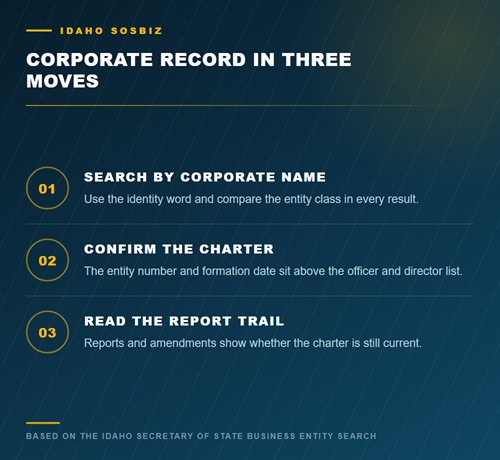
Search by Corporate Name
Use the word that carries the identity and leave the corporate ending for a second pass. Idaho stores Inc., Incorporated, Corp., and Corporation in the name field, but the match handles punctuation unevenly. Strip the suffix and any leading The, then compare the entity numbers rather than the wording. A broad word returns several pages of results. Two corporations with similar names in different counties are usually unrelated, and one may be inactive while the other is current. The charter date usually reveals why the names are close.
Search by Entity Number
A number lookup gives a single hit when every digit is right. The number appears on the articles acknowledgment, on each report, and on a standing certificate. Copy it rather than typing it, and omit spaces and dashes. A single wrong character returns a blank page that looks like a closed charter.
Reading the Corporate Result
The result list shows the name, the entity number, the type, the status, and the filing date. Open the business record to see the agent, the principal office, the officers and directors, and the filing history. That record is the document a bank or a buyer will ask you to keep.
Idaho SOSBiz corporation search:
https://sosbiz.idaho.gov/
What a Corporate Record Shows
The corporate page is terse, and each line settles a separate question. Read the fields in sequence, because a name match is not an ownership match. Idaho does not publish a shareholder schedule, so the officers and directors on file are not the owners, and the record cannot tell you who holds the shares.
Corporate Name and Type
The corporate name is the one printed on the articles of incorporation, and it carries a required ending. The type field keeps a for-profit corporation apart from a nonprofit and from an LLC with a similar name. The class sets the report rate, the governing paper, and the charge.
Entity Number and Incorporation Date
The entity number follows the corporation for life; it does not change when the name changes, the office moves, or the agent is replaced. The incorporation date is the day the articles were accepted, which is rarely the day trading began. Between them, those two fields settle contract authority, tax years, and claims about how long the business has existed.
Status
A current charter has kept up with its reports. A lapsed or closed one has stopped filing or has ended, and a revived record keeps the break in its sequence. The status page sets out each value; on this page the point is that the list can lag the detail.
Registered Agent and Office
The registered agent accepts service of process and official mail at a physical Idaho address. The agent can be an individual resident or a business entity registered with the Secretary of State. The principal office is the operating address on file, and it may trail a move by several months.
Officers and Directors
Idaho corporations report officers and directors, including a president and a secretary in most filings. The record does not show how many shares each person holds, and it does not show every officer of a large company. A signer whose name is absent from the record may still have authority under the bylaws, but a buyer should ask for the resolution that proves it.
Filing History
The history collects the articles, every annual report, amendments, agent changes, mergers, and the dissolution. A hole in that sequence usually means a dissolution followed by a reinstatement. Where a long-lived corporation shows only a few entries, ask whether documents were filed under an earlier name.
How an Idaho Corporation Is Formed
Forming a corporation takes one filing with the state plus a set of papers the office never sees. The articles create the corporation. The bylaws, the organizational meeting, and the share issuance happen after the filing and stay with the company. A corporation that issues shares also records the authorized count in the articles.
Name Rules
The name must be distinguishable from names already on the register and must carry a corporate ending such as Corporation, Incorporated, Corp., or Inc. Idaho compares names after removing punctuation and designations, so Boise Works Inc. and Boise Works Corporation are treated as the same name. Search before filing rather than after a rejection.
Articles of Incorporation
Submission runs through SOSBiz or over the counter at the Secretary of State. The document carries the charter name, the agent and offices, the incorporator, and the authorized shares. Paper adds the manual charge, and the accepted articles generate the state number.
Bylaws and the Organizational Meeting
The bylaws set the board size, the officer roles, the meeting rules, and the voting thresholds. The organizational meeting appoints the first directors and officers and adopts the bylaws. Neither document is filed with the state, but a bank and a court will ask for them when authority is disputed.
Shares and the Stock Ledger
The articles state the number of authorized shares, and that number shapes how the corporation raises money and records ownership. The public record shows the authorization, not the issuance. A corporation authorized for a million shares may have issued ten, which is why the stock ledger matters more than the record when ownership is disputed.
Issuing Shares by Board Resolution
The Idaho LLC records page covers the ownership record for an LLC. Shares are issued by board resolution and recorded in a ledger that lists each holder, the certificate number, and the date of issue. Idaho does not require the ledger to be filed, but it is the document that proves ownership. Update it whenever shares transfer, because a stale ledger is worse than no ledger in a dispute.
Authorized, Issued, and Outstanding Shares
The articles authorize a number of shares, the board issues some of them, and the outstanding count is what shareholders hold. Treasury shares are shares the corporation reacquired; they do not vote, but they still count against the authorized total in some analyses. A buyer should ask whether any shares sit in treasury before reading the ledger as a list of current owners.
The Annual Report for Corporations
A corporate report is due by the end of the formation month every year. The form repeats the agent, both offices, and the governing persons, the fields that move most often. The online route is free, while paper carries the manual charge. The report is short, and the receipt is the document that proves the filing arrived.
Report Content
The form identifies the charter and its number, confirms the agent and offices, and lists the directors and officers. The office posts it after review, and the receipt settles the arrival date. A move that never reaches the form leaves the file stale. Submit the change first so the report repeats the corrected details.
Filing Route
Annual reports are filed online through SOSBiz, and a paper form is available for a corporation that cannot file online. The online route posts faster, and the receipt is the proof that the office received the report. Keep the receipt with the corporate record rather than in an email folder.
Amendments, Mergers, and Dissolution
A corporation changes its articles by filing an amendment, and the entity number stays with the company. A merger combines two or more corporations into one, and the survivor keeps its own number. Each transaction appears in the filing history, which is where a buyer checks whether the company that signed the contract is the company that survived.
Closing With a Statement of Dissolution
Closing a corporation takes a board vote, a shareholder vote, and a statement of dissolution. The corporation still has to close its tax permit and file the last report. Any trading after acceptance is done without the protection the charter provided.
Foreign Corporations in Idaho
An out-of-state corporation entering Idaho files a foreign registration statement and appoints an Idaho registered agent. The record shows the home jurisdiction and the date the authority began. From then on the corporation files the Idaho annual report and keeps an Idaho registered office. A company that trades here without registering can struggle to enforce an Idaho contract. The home charter is not the Idaho authority; the two registrations carry different numbers.
Board Resolutions and Signing Authority
A corporation acts through people, and a resolution connects a person to the company. The bylaws name the officer roles, and a board resolution grants authority for a loan, a lease, or a large contract. A bank will ask for both before it opens an account or funds a line of credit. The resolution should name the signer, the transaction, and the limit. A general resolution that says any officer may sign anything is easy to draft and hard to defend when a dispute turns on authority. Keep the resolutions in the same file as the bylaws and the stock ledger.
The Minute Book and Written Consents
The minute book proves that the meeting happened. It holds the bylaws, the initial consents, the share issuance, and each later resolution, in date order. A bank or a buyer may ask to see it, and a corporation that cannot produce minutes for the last two years looks less settled than its record suggests.
Consents That Replace a Meeting
A written consent signed by all directors can replace a meeting. The consent should state the action, the date, and the signers, and it should be signed before the transaction rather than after it. A short consent signed at the time is better evidence than a long narrative written from memory.
What a Lender Reads
A lender reads the corporate record for continuity, authority, and disclosure. The first question is whether reports were filed and the charter stayed alive. The second is whether the signer could bind the company. The third is whether a merger or a name change was omitted from the application. A standing certificate dates the answer. A break in the sequence still draws a question when the charter is current, and the lender may want the revival date and the cause.
Public Bids and Procurement
A public bid package usually requires a certificate of existence, a copy of the articles, and proof of tax registration. The buyer is confirming that the bidder exists, that it is current, and that it can invoice the state. A package missing one of the three is set aside before the technical review.
Matching the Certificate to the Bid
The certificate must be recent, and the name on it must match the name on the bid. A bid submitted under an assumed name without the legal entity behind it is a frequent reason for disqualification. Attach the assumed name filing when the bid uses a trade name.
Corporate Name Changes
A legal name change goes in as an amendment, and the entity number carries forward. The bank file, the tax account, and any trade name that no longer fits need a fresh update. Tell the vendors too, because a transfer into an account still titled under the old name can stall. The filing history keeps both names, and the current record shows the new one. A buyer who searches the old name may find nothing, so a seller should disclose the former name in a contract or a due diligence package.
Officer Changes Between Reports
Officers change more often than owners, and Idaho does not require a filing for every change. A corporation can replace its president or secretary and report the new slate at the next annual report. The public record may lag the meeting by months, which is why a signature that depends on a title needs a resolution rather than the listed name. Keep the minutes that show the appointment, and produce them when a reviewer asks why the record differs from the signature block.
Nonprofit or For-Profit
The choice is about purpose and ownership rather than size. A for-profit corporation issues shares and answers to shareholders. A nonprofit corporation states a purpose, does not issue shares, and answers to its directors and, where applicable, its members. State nonprofit status does not create federal tax exemption; the exemption is granted by the Internal Revenue Service on its own form. A founder who plans to seek grants should decide the structure before filing the articles, because a later conversion adds a filing and a fee.
Share Classes and Par Value
The articles may authorize more than one class of stock, and the classes can carry different voting rights, dividend preferences, or liquidation terms. Ordinary shares usually vote, while preferred shares often carry a preference on dividends or a return of capital. Read the articles for the class structure before you assume one share equals one vote.
Par Value and the Balance Sheet
Par value is a separate field from the share count. A corporation can set a par value of one cent or none at all, and the figure affects how the shares are recorded on the balance sheet rather than what they cost. A buyer who reads only the authorized count can miss a class that changes control.
Closing the Corporate File
A corporation that stops trading should file a statement of dissolution, close its tax permit, and keep the final report receipt. The filing ends the charter, but the internal record still matters for a later claim, a tax review, or a sale of assets. Keep the minute book and the stock ledger after the closure.
Records to Keep After Closure
Keep the final receipt with the minute book as well. An owner who simply stops filing leaves the record to be dissolved by the state, which produces a gap that a buyer will question. A voluntary close costs less in the long run, and it leaves a sequence that speaks for itself.
Idaho Corporation Fees
The figures below are the statutory charges for corporate filings. The online price is lower than the paper price, and paper adds the manual charge. Reconcile the stock ledger with the tax return each year. A rejected document is not refunded. The table lists formation, the report, foreign registration, a certificate, and reinstatement.
| Corporate filing | Fee | Notes |
|---|---|---|
| Articles of incorporation | $100.00 | Statement filing |
| Annual report | $0.00 | Anniversary month |
| Foreign registration | $100.00 | Statement filing |
| Certificate of existence | $10.00 | Request from record |
| Reinstatement | $30.00 | Plus reports owed |
Reading a Corporate Record for a Contract
For a contract, collect the business record, a certificate of existence, and a resolution that names the signer. Read the status first, then the incorporation date, then the agent. Longevity and a stable agent do not prove quality, but they separate a settled company from one that keeps reshaping itself.
Dating the Record You Attach
Keep the printout with its date attached to the contract. If the charter is dissolved, ask for the reinstatement date; if a report is late, assume the next check will look different. A copy with a date on it answers a later question about what the file showed.
What the Corporate Record Cannot Tell You
Registration and standing are the whole of it. The file says nothing about share ownership, revenue, debts, or insurance. An assumed name sits in a state filing, and a professional credential is held by the board that issues it. Each of those facts needs its own search with the office that holds it.
Liens and Judgments Live Elsewhere
A corporation with an active status and a clean history can still carry a judgment, a lien, and a lapsed license. The Idaho LLC records page covers the parallel questions for a borrower organized as an LLC. The record is a starting point for a review, not a substitute for one.
Frequently Asked Questions
These questions come from directors checking their own filings and from buyers checking a corporate vendor. Each answer points to the office that holds the document.
Is the Idaho corporation search free?
Nothing. The register is open without an account. Only issued documents, such as copies and certificates, carry a price.
Does an Idaho corporation need a registered agent?
Yes. Every domestic and foreign corporation keeps a registered agent with a physical Idaho address. A change of agent is a separate filing.
What is the difference between a for-profit and a nonprofit corporation in Idaho?
A for-profit issues shares and elects a board. A nonprofit states a purpose, does not issue shares, and files under a different fee schedule. Federal exemption is a separate application.
Do Idaho corporations pay a franchise tax?
Idaho does not impose a franchise tax measured by authorized shares. The corporation pays income tax on its earnings and files the annual report with the state.
Can one person own an Idaho corporation?
Yes. Idaho allows a single shareholder, who can also be the sole director and officer. The bylaws should state how that person acts for the corporation.