

Idaho does not issue a single general business license that covers every company in the state. This surprises many new owners who expect one permit to sit above the whole operation. Instead, licensing in Idaho is layered: some activities are regulated by state boards, some by cities and counties, and some by both. A company can be perfectly registered with the Secretary of State and still need three separate permissions before it legally opens its doors. This page looks at licensing as distinct from entity registration.
It covers the state boards that issue occupational licenses, the local licenses that cities and counties add, the permits tied to specific activities such as food service and construction, and how to verify that a license claimed by a vendor or contractor actually exists. If you are trying to confirm who owns a company rather than what it is allowed to do, that is a different search entirely, and our Idaho company search covers the ownership side in detail.
How to Determine Which Idaho Licenses Apply to a Business
The practical method is to work outward from the activity rather than inward from the business name. Start with what the company actually does, where it does it, and who it serves. A landscaping crew that only maintains commercial lots has a different set of obligations than a crew that applies pesticide, and a coffee shop with a drive-through window has more permissions than a roastery that sells only wholesale. Listing activities first prevents the mistake of buying a general registration and assuming the rest is covered.
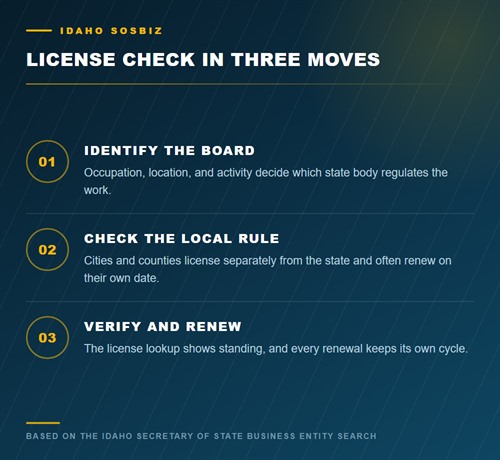
Once the activities are listed, sort them into three buckets. The first bucket holds occupations the state regulates, which in Idaho means boards under the Division of Occupational and Professional Licenses or the Idaho Bureau of Occupational Licenses. The second holds local permissions issued by a city or county, which vary enormously from one jurisdiction to the next. The third holds activity-specific permits such as food establishment licenses, alcohol licenses, and contractor registrations. Most businesses touch at least two of the three.
Label:
https://sosbiz.idaho.gov/
It also helps to separate the question of permission from the question of existence. The Secretary of State records that an entity was formed and who speaks for it. A board record shows that a person met a standard and may practice.
A city record shows that a location passed inspection or paid a local fee. These are independent facts, and one never implies another. A contractor with an active state registration can still be operating without a valid city permit, and a business with every local permit in place can still be trading under a name that was never filed.
Why Idaho Has No General State Business License
Idaho’s approach is sometimes described as registration plus regulation. The state requires entities to register and to keep their records current, and it regulates specific occupations where public safety or consumer protection justifies it. What it does not do is charge every business an annual fee simply for existing.
Why There Is No Single Record
That design keeps the cost of starting a small company low, but it also removes the one-stop reassurance that a general license provides in some other states. The consequence is that no single agency can tell an owner that they are fully compliant. The Secretary of State can confirm a filing. A board can confirm a credential. A city can confirm a local permit.
Assembling the Whole Picture
Only the owner can assemble those confirmations into a complete picture, and only the owner carries the risk of a gap. This is why due diligence matters more in Idaho than in states where a single license number functions as a proxy for legitimacy. New owners often hear that Idaho is business friendly and read that as lightly regulated.
Registration Is Simple, Regulation Is Not
The registration side is indeed simple and inexpensive, but the regulatory side is not absent. Occupational boards enforce continuing education, complaint handling, and discipline. Cities enforce zoning, signage, and fire codes. Counties enforce health rules outside municipal limits. The friendliness is in the paperwork, not in a suspension of the underlying rules.
Occupational Licenses Issued by State Boards
Occupational licensing in Idaho runs through two main structures. The Division of Occupational and Professional Licenses administers a long list of professions, from physicians and nurses to electricians, plumbers, and real estate agents. The Idaho Bureau of Occupational Licenses handles a different set of occupations, historically including barbers, cosmetologists, and several other trades.
Board Requirements and Testing
Each board within those structures sets its own application requirements, renewal cycle, and fee schedule. Because the boards set their own fees, there is no single number that describes the cost of becoming licensed in Idaho. A profession with a short application and a written examination costs far less than one requiring supervised hours, clinical training, or a practical demonstration.
Renewal Cycles Differ by Board
Renewal fees are also board-specific, and several boards add a separate charge for late renewal or reinstatement after a lapse. Anyone budgeting for licensing should read the fee schedule published by the specific board rather than relying on a figure quoted for a different profession. Applicants should also expect the board to look beyond the application form.
Background Checks and Reciprocity
Fingerprinting and background checks appear in several health and public safety occupations. Transcripts and verification of out-of-state credentials are routine where a license depends on education. Boards that issue credentials by examination publish pass rates and scoring information, and boards that issue credentials by endorsement publish the conditions under which an existing license from another state will be accepted.
Professions Licensed by DOPL
DOPL covers the largest share of regulated occupations. Its divisions include health professions, professional and occupational services, and building trades. Accountants, architects, engineers, surveyors, pharmacists, dentists, veterinarians, and social workers all fall within its reach, along with the construction trades that require journeyman or master credentials.
Divisions, Rules, and the License Lookup
Each division publishes its own statutes and rules, and those rules control the practical details of how a license is obtained and kept. One feature worth knowing is that DOPL maintains a public license lookup.
What the License Lookup Shows
Anyone can search by name, license number, or profession and see the current status, the issue date, and whether discipline has been recorded. That lookup is the fastest way to confirm whether a professional is genuinely credentialed, and it is far more reliable than a certificate framed on an office wall or a logo on a truck.
Professions Licensed Through IBOL
The Idaho Bureau of Occupational Licenses administers a smaller and more varied group of occupations. Its boards have included barbering and cosmetology, hearing aid dealers, denturitry, and several other fields where the state chose to regulate entry. IBOL publishes board rosters, meeting notices, and application materials, and it maintains its own verification service for the credentials it issues.
Finding the Right Register
The split between DOPL and IBOL matters mainly for finding the right record. If a search on one system returns nothing, the occupation may simply sit with the other. Checking both before concluding that a credential does not exist avoids a false negative, particularly for trades that moved between administrative homes over the years.
Local Licenses From Cities and Counties
Local licensing is where Idaho’s system becomes genuinely uneven. A city may require a business license, a zoning clearance, a home occupation permit, a sign permit, or a fire inspection, and the combination changes from one municipality to the next. Counties handle unincorporated areas and often add health department requirements for food and water.
Why Neighboring Towns Differ
Two businesses with identical operations can face different obligations simply because one sits inside city limits and the other does not. The reliable approach is to contact the city or county where the physical location sits, not where the owner lives and not where the mailing address points. A business with a mailing address in Boise but a shop in a smaller town answers to the smaller town.
Before Signing a Lease
Owners who lease space should confirm with the landlord and the planning department that the intended use is allowed at all, because a use permit problem can stop an opening regardless of how many other licenses are in hand. Local fees are set by the city or county and are not published in any statewide schedule.
How Local Charges Are Set
Some jurisdictions charge a flat annual amount, others scale by employee count or square footage, and others fold the business license into a broader permit. Home-based businesses often pay less but face additional limits on traffic, signage, and storage. Because these rules change with council action, an owner should verify the current requirement each year rather than relying on what a neighbor paid two years ago.
Zoning and Occupancy Clearances
A zoning clearance confirms that the proposed use is permitted at that address. It is separate from a business license and is usually handled by a planning or community development department. Occupancy rules may also apply when a space changes use, and a change of tenant can trigger a new inspection even when the building itself is unchanged.
Clearances Before a Lease
These clearances are frequently the slowest part of opening. A tenant who signs a lease before confirming the allowed use can end up with a space that cannot legally host the business. Reading the zoning designation before signing is the cheapest form of insurance available to a new operator.
Permits for Specific Activities
Beyond occupation and location, Idaho regulates certain activities directly. Food service is the clearest example. Anyone preparing or selling food to the public generally needs a food establishment license from the health district with jurisdiction, and the requirements cover equipment, temperature control, handwashing, and manager certification.
Temporary Events and Cottage Food
Temporary events, mobile units, and cottage food operations each follow separate rules with their own limits on what may be sold and where. Alcohol adds another layer. A license to sell beer, wine, or liquor comes from the state with local involvement, and the available quota depends on the jurisdiction and its population.
Cottage Food and Mobile Units
Contracting is a third area: public works and certain specialty trades require registration or licensure, and verification is expected before work begins. Each of these permits has its own renewal cycle, inspection schedule, and grounds for suspension.
Food Establishment Licensing
Food licensing in Idaho is administered by the health districts rather than by a single state office. A restaurant, grocery, commissary, or food truck applies to the district covering its location, submits plans for review before construction, and passes an inspection before opening. Plan review is often the longest lead time, and skipping it can force expensive changes after equipment is installed.
Retail Food and Processing Rules
Retail food establishments and food processing operations can fall under different rules depending on volume and distribution. A producer selling directly to consumers at a farmers market faces a lighter set of requirements than one shipping packaged goods across state lines. Owners should describe their distribution honestly during the application, because the classification drives the inspection standard applied later.
Alcohol and Contractor Permits
Alcohol licensing involves both the state and the local jurisdiction, and the local approval can include a public hearing or a distance check against schools and churches. Contractor registration is separate from occupational trades licensing: a general contractor may need registration to bid public work, while an electrician or plumber on the same job needs an individual trade credential. Both can be checked through public records, and both should be checked before a contract is signed.
How to Verify an Idaho License
Verification begins with the board that would have issued the credential. DOPL and IBOL each publish a searchable register, and both show current status and disciplinary history. Searching by individual name is a good start, but a business name search can miss a credential held personally by an owner, so searching both ways is worth the extra minute.
Recording the Number and Expiration
Note the license number and the expiration date rather than relying on a screenshot of a status page. Local licenses are harder to verify because few cities publish a searchable register. A call or email to the licensing office is usually required, and the response may take a few days.
Checking a Contractor Before Work Starts
For contractors and other trades, ask for the license number before work begins and confirm it independently rather than accepting an image of a card. The Idaho registration guide sets out which records confirm the business side of that check so the two halves can be compared. It is also worth checking whether a license covers the work being quoted.
Scope of Work by Trade
An electrical contractor’s license does not authorize plumbing, and a residential endorsement may not cover commercial projects. Scope limits are written into statute and are enforced through complaints. A vendor who balks at a request for a license number is telling you something useful.
License Compared With Business Registration
Registration creates the entity; licensing permits the activity. A newly formed LLC receives a certificate of organization and an entity number, and that filing establishes the company as a legal person able to contract and hold property. It says nothing about competence, safety, or fitness to perform regulated work.
What a Board Reviews
A license, by contrast, is granted to a person or a firm after a board satisfies itself that a standard has been met. The two records also live in different places. Entity records sit with the Secretary of State and are searched through the SOSBiz portal. License records sit with the issuing board or local unit and are searched through that body’s register.
Two Registers, Two Schedules
Confusing the two leads to bad conclusions: an active entity record is not evidence of a license, and a lapsed license does not mean the company has been dissolved. Both facts can be true at once, and each has a different remedy. Owners should keep the two current on different schedules.
Keeping Both Current
Entity records are refreshed through an annual report due at the end of the formation month, while licenses renew on the cycle the board sets. A company can be in good standing with the state while carrying an expired credential, which is exactly what a customer’s verification check is designed to catch.
Continuing Education and Renewal Obligations
A license is a continuing relationship with a board rather than a one-time purchase. Most Idaho credentials carry a renewal cycle of one or two years, and many require continuing education hours before the renewal can be approved. The board defines which courses count, how many hours must be completed, and whether any portion must cover ethics, safety, or state-specific law.
Hours a Board Will Not Accept
Hours earned in a subject the board does not recognize cannot be applied to the requirement. Recordkeeping is the weak point for most small operators. Certificates of completion arrive by email, get saved to a downloads folder, and are forgotten until renewal season.
Keeping Certificates for an Audit
A simple practice prevents the problem: create a folder for each credential, save every certificate as it arrives, and log the completion date in a calendar entry that also shows the renewal deadline. When a board audits a renewal, the burden of proof sits with the licensee.
Lapses and Reinstatement
Practicing on a lapsed license is treated as practicing without a license, even when the lapse was an oversight and the renewal payment was simply late. Boards publish the conditions for reinstatement, which may include a fee, proof of continuing education for the missed period, and in some cases an examination or a review of practice history. The longer the lapse, the more conditions tend to apply.
Supervising Licensed Employees
Firms should also watch the credentials of employees who work under a supervisor’s license. If the qualifying license lapses, the work performed under it may be called into question, and permits issued on the strength of that credential can be affected. Checking status before assigning regulated work is a routine safeguard rather than a sign of distrust.
When a License Is Denied or Disciplined
Boards may deny an application, place conditions on a license, suspend it, or revoke it. Grounds typically include incomplete or inaccurate applications, criminal history that bears on fitness, failure to meet education or examination requirements, and conduct that violates the practice act. Because licensing is administrative rather than criminal, the standard of proof and the procedures differ from a courtroom, and the hearing process follows the board’s own rules.
Fee Schedule for Licensing Categories
The table below collects the fee categories discussed on this page. Only one figure is fixed by statute; the rest are set by the board or local unit that administers them, so the entries appear as descriptions rather than amounts. Nothing here replaces the published schedule for a specific profession or city.
| Filing | Fee | Notes |
|---|---|---|
| General state business license | None | Registration is separate |
| Occupational license | Set by board | DOPL or IBOL |
| Local license | Set by city or county | Permit or business license |
| License verification | No fee | Search the board register |
Because board fees change through administrative rule and local fees change through council action, an owner should confirm the current amount at the moment of application.
Recordkeeping and Renewal Discipline
Licensing failures are rarely dramatic. They usually begin with a renewal notice that arrived at an old address, or a continuing education certificate that was never uploaded, or a local permit that lapsed because the owner assumed it renewed automatically. Keeping a single calendar that lists every credential, its expiration date, and the name of the issuing body prevents most of these problems before they start. Store copies of applications, approvals, and inspection reports in one place, and note the license number on each.
Frequently Asked Questions
These questions come up most often when owners compare licensing obligations with registration records.
Does Idaho require a general business license for every company?
No. Idaho has no single general state business license. Registration with the Secretary of State is required for most entities, but permission to operate comes from occupational boards, cities, counties, and activity-specific permit programs rather than from one statewide license.
Which agency handles occupational licensing in Idaho?
The Division of Occupational and Professional Licenses handles the largest group of professions, and the Idaho Bureau of Occupational Licenses handles a separate set of occupations. Each board inside those structures sets its own application requirements and renewal cycle.
Are local business licenses required in every Idaho city?
No. Requirements vary by jurisdiction. Some cities require a business license and zoning clearance, while others impose only specific permits. Counties handle unincorporated areas and often add health requirements, so the location of the physical premises determines which rules apply.
Can a business hold a state registration without any license?
Yes. Registration and licensing are separate. A company can be in good standing with the Secretary of State while holding no occupational credential at all, because registration establishes the entity and licensing permits regulated activity.
How can a customer confirm that an Idaho license is valid?
Search the register maintained by the issuing board. DOPL and IBOL both publish lookup tools showing status and discipline, while local licenses usually require a call to the city or county licensing office. Confirm the license number, expiration date, and scope of work covered.