

The registered agent field is the least glamorous part of an Idaho business record and one of the most useful. It identifies the person or company that agrees to accept legal papers on behalf of a business, and it must be kept current for as long as the entity exists. When a lawsuit, a subpoena, or a formal state notice arrives, the agent is the address where it lands. If that address is wrong, the business may never learn that a case was filed. Public records make the field visible.
Anyone searching the Secretary of State’s portal can see the agent’s name and the Idaho street address on file, along with the entity number and status. Reading that entry correctly, and knowing what it does not tell you, is the point of this page. For the wider set of ownership and filing records around it, our Idaho company search covers how those pieces fit together.
How to Read the Registered Agent Field in SOSBiz
The agent entry appears on the entity detail page alongside the formation date, the entity type, and the current status. It typically shows a name and a full street address, sometimes with a separate mailing address listed nearby. The street address is the operative one, because that is where service must be possible.
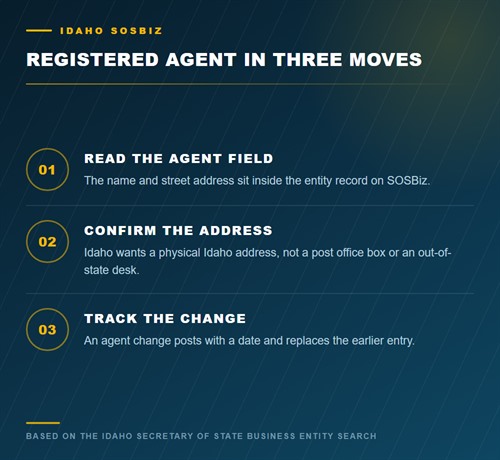
A mailing address that differs from the street address is informational rather than a substitute. Two details deserve attention. First, the name shown may be either an individual or a commercial service, and the two carry different implications for how contact works. Second, the address must be a physical location in Idaho. If a record shows a post office box, an out-of-state address, or a vacant lot, the filing is defective on its face, and the entity may be exposed to default judgments it never sees.
Label:
https://sosbiz.idaho.gov/
SOSBiz also shows whether the entity is in good standing and when its last annual report was processed. Those fields matter when judging whether the agent record is likely to be current. An entity that has fallen behind on reports may still list an agent who resigned months earlier, because the resignation takes effect on the record only when a new agent is appointed or the resignation is properly filed.
Individual Agents and Commercial Agents
An individual agent must be a resident of Idaho and must maintain a physical Idaho street address where service can be delivered during business hours. That person can be an owner, an officer, a family member, or an unrelated professional. The role is not honorary: accepting service creates a duty to forward papers promptly, and ignoring that duty can harm the entity far more than the underlying dispute would have.
Commercial Agent Services
A commercial agent is a business entity registered with the Secretary of State that provides the service professionally, usually for an annual charge. Many companies that operate across state lines use one because it supplies a stable address through moves, staff turnover, and changes of ownership.
Cost, Continuity, and Consent
The trade-off is cost against continuity, and for a company with no fixed Idaho office the commercial option often removes a recurring source of risk. Either way, the agent must consent to the appointment. Using someone’s name and address without agreement is both unreliable and, in practice, a way to lose a default judgment. An agent who never agreed to serve has no reason to forward anything.
Residency and Physical Address Rules
The physical address rule is strict. A post office box will not satisfy it, and neither will a mailbox store that cannot accept service of process in person. The address must identify a real location in Idaho where a person can be found. Assumed business name filings cannot serve as an agent either, since a trade name is not a legal person capable of accepting service.
Home Addresses and the Public Record
Agents who work from home should think carefully before listing a residence. The address becomes part of the public record and stays there for as long as the appointment lasts. A commercial agent or a rented office address keeps the home out of that record, which is the usual reason owners choose one.
Service of Process and Why the Address Matters
Service of process is the formal delivery of legal documents that starts a lawsuit or gives notice of a proceeding. In Idaho, service on the registered agent is service on the entity. That means a complaint delivered to the agent’s office is legally effective even if the owner never personally holds the paper. The clock on a response begins when service is complete, not when the owner happens to hear about it.
A Stale Record and a Default Judgment
This is where a stale record becomes expensive. If the agent moved and the filing was never updated, a plaintiff may serve the last address of record and proceed. The entity then fails to answer, and a default judgment follows. By the time the owner discovers the problem, the window to respond has closed and the options are limited to reopening the case or appealing, both of which are harder and costlier than answering would have been.
State Notices Follow the Same Addresses
The same logic applies to state correspondence. Annual report reminders, notices of administrative dissolution, and inquiries from the business entities office all route through the addresses on file. An agent who forwards mail reliably keeps the entity informed; an agent who does not turns routine paperwork into a crisis.
Changing the Registered Agent or Office
Idaho allows a change of agent or agent address to be filed online at no state charge. A paper filing carries a manual processing fee. The change takes effect when the filing is processed, and the record then shows the new name and address. Until that moment, the old agent remains the agent of record, which is why a resignation and a replacement are usually filed together rather than weeks apart.
What the Change Filing Contains
The filing itself is short. It identifies the entity, states the new agent’s name and street address, and includes the new agent’s consent. Errors appear often in the address line, particularly when a suite number is dropped or a postal abbreviation is used inconsistently. Because the address is the functional part of the record, a small formatting mistake can defeat the purpose of the whole filing.
Updating Contracts and Internal Records
Companies should also update their internal records at the same time. Contracts, bank authorizations, and insurance policies often list the agent or the principal office, and leaving those documents out of alignment creates confusion later when a lender or a counterparty checks the public record against what the company provided.
Resignation and the Replacement Window
An agent who wishes to resign files a statement of resignation with the Secretary of State and gives notice to the entity. The resignation does not instantly leave the entity without an agent; it takes effect when a new agent is appointed or after a set period, whichever comes first. That gap is deliberate, giving the company time to line up a replacement without a lapse in service.
Acting on a Resignation Notice
Owners who receive a resignation notice should treat it as urgent. A lapse in the agent field can lead to administrative action against the entity and complicates any later reinstatement. Appointing a successor promptly, and confirming that the filing was processed rather than merely submitted, closes the gap.
Privacy and the Home Address Problem
Idaho does not allow an entity to hide its registered agent behind a state-held confidential address in the way some jurisdictions do. The address on file is public. For a sole owner working from a house, that means a home address becomes searchable by anyone with an internet connection, including clients, competitors, and people the owner would rather not hear from. The practical solutions are limited and well known.
Practical Ways to Keep a Home Off the Record
A commercial agent service supplies a public address that is not the owner’s home. Renting a small office or using a coworking location with a real street address achieves something similar. A post office box does not, because it fails the physical address rule and would leave the filing defective. Owners should also consider what other filings reveal.
Other Filings That Carry an Address
Principal office addresses, assumed business name records, and local licenses can all expose a residence even when the agent address has been moved to a service. Coordinating those records is a project in itself, and it is easier to plan before the filings are made than to unwind them afterward. Records tied to the company itself are catalogued in our guide to Idaho LLC records if you need to trace which documents carry an address.
What the Agent Field Does Not Prove
The agent field is an administrative contact point, not a statement of ownership. A commercial agent may appear on thousands of entities and have no economic interest in any of them. An individual agent may be a lawyer, an accountant, or a relative with no shares at all. Reading the field as an ownership signal is one of the most frequent mistakes made by people new to public records.
Status and Compliance Are Separate
Nor does the field establish that the entity is active, solvent, or compliant. A record can show a valid agent while the entity is suspended for failing to file reports. It can show an agent who resigned without a successor being named. It can show an address that no longer exists. None of those conditions is corrected by the presence of an agent entry.
Authority Does Not Come From the Agent
Finally, the field says nothing about authority. An agent is not automatically an officer, a manager, or someone who can sign contracts. Authority comes from the formation documents, the operating agreement, and the resolutions of the entity, not from the agent appointment. Anyone relying on the field to decide who can bind a company is looking at the wrong document.
Cross-Checking Related Records
Confirmation usually requires more than one record. The entity detail page shows the agent and status. The annual report shows the principal office and the members or managers listed at the time of filing. Filings history shows when changes were processed. Reading all three together produces a picture that no single page provides.
When Records Disagree
Where the records conflict, the most recently processed filing controls. A pending submission that has not yet cleared the queue does not change the public record, even if the filer has a confirmation receipt. The portal publishes a processed-through date, and comparing a filing date against that date tells you whether the change is live or still waiting.
Annual Reports and Agent Continuity
The recurring report keeps the entity compliant, and its deadline is the end of the formation month. The portal route costs nothing, while paper adds the manual charge. Because the form restates the agent and the office, it doubles as an annual check on both. Owners should use that checkpoint deliberately.
Using the Report as a Checkpoint
Confirm that the agent still consents, that the street address is still correct, and that the mailing address reaches someone who opens the mail. An agent who has moved without updating the record is a problem that the annual report can catch before a lawsuit does. Entities that file early leave room to correct a mistake before the deadline passes.
When the Report Is Missed
Missing the report has consequences that compound. The entity may be administratively dissolved or revoked, and reinstatement requires paperwork and payment. During the gap, the entity’s ability to contract or defend a suit can be challenged. The agent field is part of that same record, so a lapsed entity and a stale agent address often appear together.
Choosing Between an Individual and a Service
The choice turns on stability and exposure. An individual agent is inexpensive and often convenient, particularly when the agent is an owner who works at the business location. The risk is that the individual moves, changes jobs, or loses interest, and the record is not updated. A commercial service costs money each year but removes that risk and keeps a home address out of the public file.
Owners in Dispute
Companies with multiple owners should also consider what happens during a dispute. An agent who is also a feuding member may not forward a complaint reliably, and the entity can suffer while the owners argue. A neutral commercial agent avoids that conflict entirely. The fee is small relative to the cost of a default judgment.
Agent Address Compared With the Principal Office
Two addresses appear on most Idaho entity records, and they are not interchangeable. The registered agent address is where legal service and official notices go. The principal office address is where the business conducts its affairs, and it may sit outside Idaho.
Where Notices Get Sent
Lenders, landlords, and counterparties sometimes read whichever address appears first and assume the other does not exist, which leads to mail sent to a place where nobody processes it. A company can legitimately keep its principal office in another state while maintaining an Idaho agent for service.
Out-of-State Principal Offices
That structure is normal for firms that operate in several states but registered in Idaho to do business there. What is not acceptable is allowing the agent address to lapse into a post office box or an abandoned suite while the principal office continues to receive ordinary commercial mail.
Which Address Receives State Notices
Official correspondence from the business entities office generally routes to the addresses on the record, and the agent is the statutory recipient for service. In practice, notices can reach either address depending on the filing and the process used. Owners should make sure both addresses have a human being who opens envelopes and acts on what is inside, rather than assuming the agent handles everything.
Handoffs Between Two Firms
Where the two addresses sit at different firms, the handoff deserves a written arrangement. A commercial agent forwards documents; it does not answer a complaint, sign an annual report, or make decisions about a lawsuit. The entity retains those duties, and the time limits that come with a served document are short.
Frequent Mistakes in Agent Filings
The most frequent error is naming an agent who never agreed to serve. A second is listing a location that cannot accept in-person delivery, such as a mailbox store or a virtual office without a reception desk. Both mistakes produce a record that looks complete in the portal and fails the moment it matters. Neither is corrected by filing an annual report that repeats the same information.
Treating a Submission as Processed
Another recurring problem is filing a change without confirming that it was processed. The portal accepts submissions into a queue and publishes the date through which filings have cleared. A filer who sees a confirmation page but not a processed filing has not changed the public record. Relying on the submission alone can leave an entity exposed during the gap, particularly if the outgoing agent has already stopped forwarding mail.
Small Address Changes That Break Delivery
Owners also forget to update the agent after a move that seems minor. A suite renumbering, a building rebranding, or a street renaming can all break delivery. Because the address is checked mechanically by whoever serves papers, a technically different address may be treated as no address at all. When in doubt, file the change and keep the record exact.
Checking an Agent Record Before You Rely on It
A verification pass takes only a few minutes and answers most of the questions a customer, lender, or prospective partner would ask. Open the entity record, note the entity number and status, read the agent name and street address, and compare the formation date against the filing history. Then check the processed-through date to see whether the record includes everything that has been submitted.
Checking the Agent’s Own Standing
Next, confirm the agent’s own standing if it is a commercial service. A company acting as agent must itself be registered with the Secretary of State, and its registration can be checked in the same portal. An agent entity that has been dissolved or revoked is a warning sign, since its own filings have lapsed while it continues to appear on client records.
What the Record Actually Establishes
Finally, decide what the record actually establishes. It confirms a filing, not a relationship. If the question is who owns the company or who can sign for it, the agent field will not answer it, and the operating agreement or the annual report is the better place to look. Treating the agent field as a shortcut to those answers is how confusion starts.
Fee Schedule for Agent and Entity Records
The table below lists the state charges connected to the agent record and the filings that most often accompany a change. Amounts are those published by the Secretary of State; local licenses and professional services are billed separately by the bodies that issue them. The table covers the agent change, the report that confirms the agent, and the certificate a reviewer may request.
| Filing | Fee | Notes |
|---|---|---|
| Change of registered agent | $0.00 | Recurring report |
| Annual report | $0.00 | Recurring report |
| Certificate of existence | $10.00 | Dated standing document |
A certificate of existence is often requested by banks, landlords, and out-of-state agencies that want independent confirmation the entity is active. It is issued per certificate and reflects the record as of the date it is produced, so a certificate obtained months ago may not satisfy a reviewer today.
Frequently Asked Questions
These questions come up most often after someone reviews an agent entry and wants to know what it proves.
Who can serve as a registered agent in Idaho?
An Idaho resident acting personally, or a company authorized to do business in the state. Either way the appointment needs a physical street address for delivery. A mailbox fails the test, and a trade name cannot hold the role.
How much does it cost to change the registered agent?
Filing the change online carries no state charge. A paper filing adds a manual processing fee. The change appears on the public record once it is processed, so a submitted filing that is still in the queue has not yet taken effect.
What happens if the registered agent resigns?
The agent files a statement of resignation and notifies the entity. The resignation takes effect when a successor is appointed or after a set period. The entity should appoint a replacement promptly to avoid a lapse that could lead to administrative action.
Is a registered agent the same as an owner?
No. The agent is a contact for legal service and state correspondence. Ownership and management authority come from the formation documents and the operating agreement, not from the agent appointment. A commercial agent typically has no ownership interest at all.
Can a home address be kept off the public record?
The agent address is public, so listing a residence exposes it. Using a commercial agent service or a real office address keeps the home out of that field. A post office box is not an alternative because it fails the physical address requirement.